The Giant’s Causeway is one of the most iconic and recognisable natural wonders of the world. Here at The Giant’s Causeway Tour, we like to think we know a thing or two about Northern Ireland’s main attraction, so here is a snippet of what you can learn during the tour.
Formation
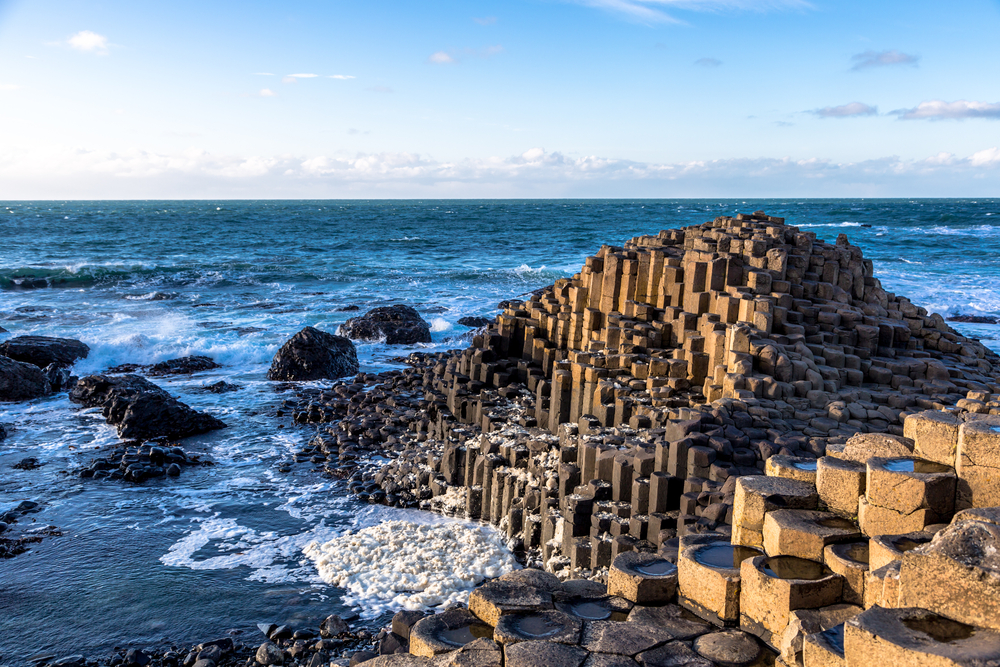
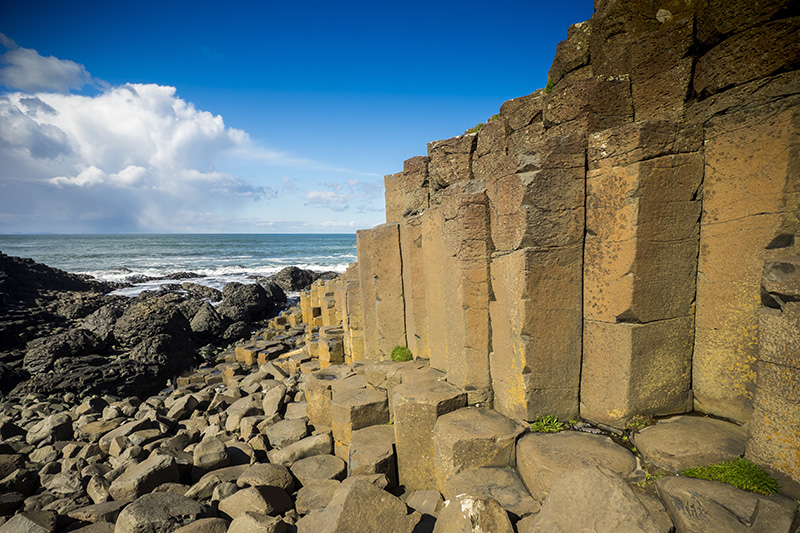
The Giant’s Causeway was formed 50-60 million years ago during a volcanic eruption. The ground at the time was made from chalk, a soft material that was easily penetrated by molten basalt due to the eruption. As the basalt lava cooled, it began to contract and fracture, splitting the basalt into the predominantly hexagonal pillars that are so recognisable today.
The Legend
The Giant’s Causeway gained its name due to the Irish myth surrounding its formation. Most likely because of the Causeway’s uniform and unusual shape, the people of Ancient Ireland created a fable to understand how the Causeway was created.
Without spoiling the whole myth, the story centred around two Giants – one named Fionn and one named Benandonner. The two Giant’s were rivals but they were kept from fighting because one lived on the Irish coast and the other lived across the sea, on the Scottish coast, where some similar rock formations can be found. Eventually, Benandonner (who lived on the Scottish side), created a bridge to cross the sea to challenge his rival; hence the name, The Giant’s Causeway.
The Columns
There are 40,000 basalt columns making up the Giant’s Causeway and most of them are hexagonal in shape. Other shapes exist, including completely cylindrical columns that were created due to weathering from the waves of the sea; these circular columns are locally called Giant’s Eyes.
In addition to the varying shapes, the columns of the Giant’s Causeway also vary in size. The diameter of the pillars vary between 38 and 51 centimetres, whilst the tallest columns can reach up to 12 metres in height. Many make the mistake of thinking that the pillars reach up to 28 metres in height but this is actually the depth of the cooled basalt at its thickest section, not the height of the pillars.
Shipwrecks
The Giant’s Causeway and its unique rock formations have claimed many ships in the past, with divers constantly exploring the area and discovering old treasures. Most notably, in 1588, a Spanish galleass named La Girona was leaving the port of Killybegs Harbour after being repaired and was blown off course into the rocks of the Causeway. The ship was wrecked and only nine of the 1300 men aboard survived. You can read more about the shipwreck here.
The Discovery in 1692
Whilst humans had been living around The Giant’s Causeway for millennia, the Causeway wasn’t officially recognised for its uniqueness and rarity until 1692, when the Bishop of Londonderry visited the area with his student. The Bishop was intrigued by what he found and recounted his visit to colleagues in Dublin and London. A year later, Sir Richard Bukeley of Trinity College, Cambridge, visited the site and wrote a paper on it, leading to investigations into the origins of the peculiar rocks and eventually, our modern day understanding of the Causeway.
Europe’s First Ever Hydro-Electric Tramway in 1883
Just under two hundred years after the formal discovery of the Causeway, it became home to Europe’s first hydro-electric tramway in 1883. This achievement also pioneered the first practical electric tramway in the world of any kind. The tramway ran between the towns of Portrush and Bushmills, passing the Giant’s Causeway along the way. It was used regularly and successfully operated for over 65 years until 1949.
Northern Ireland’s First and Only UNESCO World Heritage Site
In 1986, The Giant’s Causeway was designated as a UNESCO World Heritage Site – the first and only one in Northern Ireland. This catapulted the natural wonder even further into international fame and has allowed it to be preserved efficiently.
Rare Flora and Fauna
The Giant’s Causeway isn’t just home to incredible rock formations, it also houses a variety of animals and some extremely rare plants, including the sea-spleenwort, hare’s foot trefoil, frog orchid and oyster plant.
Potato Festival
For over half a decade, The Giant’s Causeway has hosted the Randox Northern Ireland Potato Festival which mixes family fun with locally produced potato products. Who would’ve known that one of the world’s most recognisable natural phenomenon is also home to a festival celebrating one of the most recognisable vegetables?
The Visitors
In 2017, The Giant’s Causeway reached an incredible milestone, boasting a million visitors over the twelve months and solidifying itself as one of the UK’s most impressive and popular natural wonders. This was further supported by the £18.5 million spent on an eco-friendly, grass-roofed, water-recycling visitors centre opened in 2012.
The Legacy and Impact of the Causeway
The Giant’s Causeway has inspired countless artists, writers and individuals, from being featured on a Led Zeppelin cover to being used as a filming location for HBO’s Game of Thrones. Without a doubt, it will inspire many more in the future.
These Giant’s Causeway facts are only the tip of the iceberg. Join us on The Giant’s Causeway Tour and you can discover all there is to know about this incredibly beautiful coastal feature.